
STOP-NCD
STOP-NCD is a five-year National Institute for Health and Care Research (NIHR) Global Health Research Centre which aims to improve the health and wellbeing of populations in West Africa through comprehensive and sustainable capacity strengthening for high-quality applied non-communicable disease (NCD) research.
Work Packages
To meet its objectives, STOP-NCD structures its activities across eight work packages (WPs):
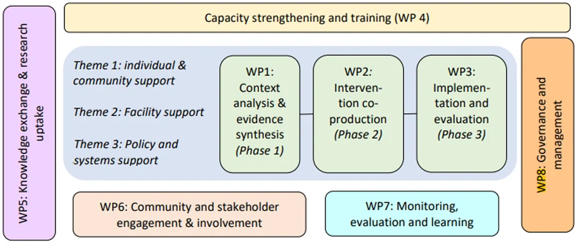
Figure: STOP-NCD work package structure, showing how WP1–WP3 (context analysis, intervention co-production, and implementation and evaluation) are addressed across the three research themes, supported by WP4 (capacity strengthening and training), WP5 (community and stakeholder engagement), WP6 (knowledge exchange and research uptake), WP7 (monitoring, evaluation and learning) and WP8 (governance and management).
Context Analysis and Evidence Synthesis
Stakeholder analysis and comprehensive analysis of the socio-political-cultural-economic contexts of NCD service provision and use at system, community, household and individual levels, using secondary data analysis, observations, in-depth interviews and a systematic review.
Intervention Co-production
Regular engagement with key stakeholders — patients, communities, service providers, managers and policymakers — to co-produce context-adapted intervention packages through four-step action research cycles, avoiding a 'travelling model' approach where interventions are carried inappropriately across settings.
Implementation and Evaluation
Implementation of intervention packages through local structures and processes to ensure sustainability, with evaluation of feasibility, acceptability, clinical effects, equitable reach and cost-effectiveness. Evaluation combines formative methods (observations, interviews, service data and documentary analysis) with a summative quasi-experimental stepped-wedge design (routine service data, household surveys, interviews, focus groups, observations and document reviews).
Capacity Strengthening and Training
Targets individual, organisational and system-level capacities of researchers (particularly earlier-career staff) and their organisations, of communities, and of policymakers and practitioners implementing evidence-based NCD interventions.
Knowledge Exchange and Research Uptake
Development and implementation of a knowledge exchange and research uptake strategy, informed by mapping the knowledge preferences and expectations of communities, practitioners and policymakers.
Community and Stakeholder Engagement and Involvement
Regular engagement with communities and stakeholders for co-producing, implementing and evaluating interventions and research uptake, including country-specific multi-stakeholder forums that ensure representation of neglected community voices in NCD research.
Monitoring, Evaluation and Learning
Development and implementation of a comprehensive monitoring, evaluation and learning strategy capturing key milestones across the three research phases, using metrics for equitable partnerships, research, capacity strengthening and overall impact.
Governance and Management
Coordination of the Centre through appropriate and equitable governance and management arrangements, supporting continuous communication with partners, the funder and other key stakeholders.