
STOP-NCD
STOP-NCD is a five-year National Institute for Health and Care Research (NIHR) Global Health Research Centre which aims to improve the health and wellbeing of populations in West Africa through comprehensive and sustainable capacity strengthening for high-quality applied non-communicable disease (NCD) research.
Overview
STOP-NCD is a five-year National Institute for Health and Care Research (NIHR) Global Health Research Centre which aims to improve the health and wellbeing of populations in West Africa through comprehensive and sustainable capacity strengthening for high-quality applied non-communicable disease (NCD) research.
Funded by the National Institute for Health and Care Research (NIHR) between 2022 and 2027, the NIHR Global Health Research Centre for Non-Communicable Disease Control in West Africa (STOP-NCD) is a partnership between the Ghana College of Physicians and Surgeons (GCPS), the London School of Hygiene & Tropical Medicine (LSHTM), Ashesi University, the Laboratoire d'Etudes et de Recherche sur les Dynamiques Sociales et le Développement Local (LASDEL, Niger), and the Université Catholique de l'Afrique de l'Ouest – Unité Universitaire à Bobo-Dioulasso (UCAO-UUB, Burkina Faso).
The Centre addresses the urgent need to improve control of non-communicable diseases in West Africa, where healthcare has traditionally been neglected and driven by disease-specific programmes, with limited engagement of local communities.
Aims and Objectives
Centre Goal
Improve health of West African populations through comprehensive and sustainable capacity strengthening for high-quality applied NCD research, to improve the prevention, diagnosis and management of hypertension, diabetes and related common mental disorders (anxiety, stress and depression).
Centre Ambition
Leave a legacy of person-centred, integrated (not disease-specific) and system-wide responses to inter-connected NCDs at community and primary care levels, through African-led research by high-calibre scholars embedded within supportive institutions, networks and policy environments — ultimately contributing to reduced premature mortality from NCDs and improved health, wellbeing and socio-economic outcomes.
Capacity Strengthening Approach
The Centre uses comprehensive and sustainable approaches to capacity strengthening, improving individual, organisational and system-level capacities of:
Researchers
Particularly earlier-career staff, for high-quality applied NCD research.
Local Communities
To engage with and improve behaviours and decisions affecting their health.
Policymakers & Practitioners
To implement evidence-based NCD interventions at scale.
Research Process
To achieve this, STOP-NCD works in three West African countries — Ghana, Burkina Faso and Niger — with varying ethnic, social, cultural and economic environments, to develop, implement and evaluate ways of improving control of hypertension, diabetes and related stress, anxiety and depression. The project:
1. Analysis
Begins by analysing the roles of key stakeholders (patients and communities, health workers, managers, policymakers) in the development, provision and use of NCD policies, programmes and services in each country, using methods such as analysis of available data, observations and interviews.
2. Co-production
Works closely with those stakeholders to co-produce packages of interventions for improving NCD control, including adapting international guidelines to local contexts, supporting healthcare workers to implement these, and establishing community-based prevention, early detection and management of NCDs.
3. Implementation & Evaluation
Implements and rigorously evaluates the intervention packages for their costs and effectiveness, assesses their potential for wide-scale application, and identifies transferable lessons for improving NCD control beyond the three countries.
Specific Objectives
- 1 Deepen understanding of contextual influences and effective pathways to prevention, diagnosis and management of NCDs in West Africa.
- 2 Co-produce, with key stakeholders, contextually adapted packages of interventions for prevention, diagnosis and management of NCDs at community and primary care levels, and conduct formative process evaluation.
- 3 Implement the intervention package through existing health systems in each country, and evaluate its feasibility, acceptability, clinical effects, equitable reach and cost-effectiveness.
- 4 Comprehensively and sustainably strengthen the capacities of researchers, communities and decision-makers for high-quality applied NCD research and its uptake.
- 5 Ensure effective research communication and uptake into the policies and practices of patients, communities, service providers and national/West African decision-makers.
- 6 Continuously engage with key stakeholders at community, sub-national and national levels within each country and within West Africa.
- 7 Establish and maintain equitable partnerships between West African and UK applicants, through shared leadership and governance arrangements.
Work Packages
To meet its objectives, STOP-NCD structures its activities across eight work packages (WPs):
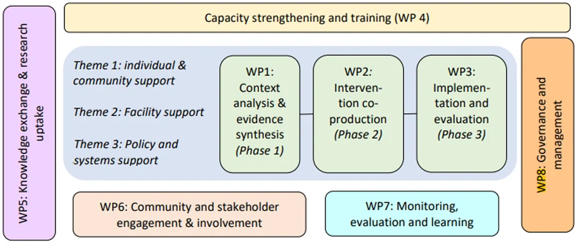
Figure: STOP-NCD work package structure, showing how WP1–WP3 (context analysis, intervention co-production, and implementation and evaluation) are addressed across the three research themes, supported by WP4 (capacity strengthening and training), WP5 (community and stakeholder engagement), WP6 (knowledge exchange and research uptake), WP7 (monitoring, evaluation and learning) and WP8 (governance and management).
Context Analysis and Evidence Synthesis
Stakeholder analysis and comprehensive analysis of the socio-political-cultural-economic contexts of NCD service provision and use at system, community, household and individual levels, using secondary data analysis, observations, in-depth interviews and a systematic review.
Intervention Co-production
Regular engagement with key stakeholders — patients, communities, service providers, managers and policymakers — to co-produce context-adapted intervention packages through four-step action research cycles, avoiding a 'travelling model' approach where interventions are carried inappropriately across settings.
Implementation and Evaluation
Implementation of intervention packages through local structures and processes to ensure sustainability, with evaluation of feasibility, acceptability, clinical effects, equitable reach and cost-effectiveness. Evaluation combines formative methods (observations, interviews, service data and documentary analysis) with a summative quasi-experimental stepped-wedge design (routine service data, household surveys, interviews, focus groups, observations and document reviews).
Capacity Strengthening and Training
Targets individual, organisational and system-level capacities of researchers (particularly earlier-career staff) and their organisations, of communities, and of policymakers and practitioners implementing evidence-based NCD interventions.
Community and Stakeholder Engagement and Involvement
Regular engagement with communities and stakeholders for co-producing, implementing and evaluating interventions and research uptake, including country-specific multi-stakeholder forums that ensure representation of neglected community voices in NCD research.
Knowledge Exchange and Research Uptake
Development and implementation of a knowledge exchange and research uptake strategy, informed by mapping the knowledge preferences and expectations of communities, practitioners and policymakers.
Monitoring, Evaluation and Learning
Development and implementation of a comprehensive monitoring, evaluation and learning strategy capturing key milestones across the three research phases, using metrics for equitable partnerships, research, capacity strengthening and overall impact.
Governance and Management
Coordination of the Centre through appropriate and equitable governance and management arrangements, supporting continuous communication with partners, the funder and other key stakeholders.
Research Themes
STOP-NCD's three research themes reflect the level of support for person-centred, integrated and system-wide responses to inter-connected NCDs:
Individual and Community Support
Empowering individuals and communities with awareness, skills and resources to understand and manage NCD risk factors and health-seeking behaviours.
Primary Healthcare Facility Support
Strengthening primary care delivery for integrated NCD prevention, diagnosis and management, supported by well-equipped and motivated health workers.
Systems and Policy Support
Creating enabling policy environments and health system arrangements that sustain person-centred, integrated NCD responses at scale.
These themes are interrelated and complementary — for example, individual awareness of the nature and importance of NCD risk factors affects health-seeking behaviours, while facility-based care depends on staff support and an enabling policy environment. Work within each theme is organised according to the Centre's three research work packages (context analysis and evidence synthesis; intervention co-production; and implementation and evaluation), with each theme addressed through country-specific research projects.
Community and Stakeholder Engagement
STOP-NCD's approach is underpinned by a commitment to transformative engagement with individuals and groups through mutually respectful, inclusive and ethical research.
Participatory Co-production
Using action-reflection cycles to enable an in-depth understanding of intersecting experiences of marginalisation and exclusion, and allowing communities to identify and articulate their own needs.
Multi-stakeholder Forums
In each country, the Centre establishes an in-country multi-stakeholder forum comprising 15–20 decision-makers, health workers, managers, practitioners and civil society organisations. These advisory bodies help represent all voices in NCD research and provide a platform for cross-stakeholder exchange, engagement, advocacy and joint decision-making.
Engage People Living with NCDs
Central to the Centre's plans is engaging and involving people living with NCDs, their families and carers, including those often marginalised, through close partnerships with civil society organisations working in their respective languages and social contexts.
Creative Approaches
The Centre identifies and adapts creative approaches such as photovoice, participatory film-making and local theatre, with continued cross-country peer exchange to maximise impact for local people and communities.
Capacity Strengthening
STOP-NCD uses comprehensive and sustainable approaches to capacity strengthening, improving individual, organisational and system-level capacities of researchers (particularly earlier-career staff), local communities, and policymakers and practitioners.
Training & Education
Post-graduate training, short courses and workshops tailored to researchers, practitioners and community members.
Mentorship & Exchange
Structured mentorship support, cross-organisational exchange and learning, and communities of practice.
Co-production
The co-production process itself builds shared understanding, skills and ownership among all partners.
The Centre is currently supporting a number of doctorate and master's students across its partner institutions, including at LSHTM, Lancaster University, UMC Utrecht, Université de Montréal, Université Nazi Boni and Université Joseph KI-Zerbo, among others.
Who We Are
STOP-NCD's partnership is led by the London School of Hygiene & Tropical Medicine (LSHTM) and the Ghana College of Physicians and Surgeons (GCPS), the Centre's joint lead organisations, and involves Ashesi University (AU), the Laboratoire d'Etudes et de Recherche sur les Dynamiques Sociales et le Développement Local (LASDEL, Niger), and the Université Catholique de l'Afrique de l'Ouest – Unité Universitaire à Bobo-Dioulasso (UCAO-UUB, Burkina Faso). STOP-NCD is hosted by LSHTM and GCPS.
Partner Institutions

- London School of Hygiene & Tropical Medicine (LSHTM), United Kingdom
- Ghana College of Physicians and Surgeons (GCPS), Ghana
- Ashesi University, Ghana
- Laboratoire d'Etudes et de Recherche sur les Dynamiques Sociales et le Développement Local (LASDEL), Niger
- Université Catholique de l'Afrique de l'Ouest – Unité Universitaire à Bobo-Dioulasso (UCAO-UUB), Burkina Faso
International Advisory Committee
The Centre's work is further guided by an international Advisory Committee
- The Centre's work is further guided by an international Advisory Committee chaired by Prof. Kerstin Klipstein-Grobusch (University Medical Center Utrecht, The Netherlands), with members drawn from institutions including York University (Canada), the Public Health Foundation of India, the University of Montreal, Johns Hopkins University (USA), and Université Abdou Moumouni (Niger).
Outputs
The STOP-NCD consortium has produced a growing body of peer-reviewed publications spanning hypertension and diabetes care, primary health system capacity, mental health service access, and the use of artificial intelligence in NCD risk prediction.
Articles in Peer-Reviewed Journals
Can artificial intelligence bridge critical gaps in hypertension prediction and risk assessment in low- and middle-income countries? A scoping review
Institutional capacity for non-communicable disease care in Ghana's primary health care system: a multi-method study
Assessing the drivers of non-communicable diseases prevention activities in primary health care facilities in Ghana: a case study of some selected districts
Disparities in the access and provision of mental health services as part of primary health care: a case study of Ga-South district in the Greater Accra region
Estimating the prevalence, socioeconomic determinants, and health seeking behavior of individuals with depression in Ghana
Barriers and facilitators of primary care management of type II diabetes mellitus in the West African sub-region: A scoping review
Impact of health systems interventions in primary health settings on type 2 diabetes care and health outcomes among adults in West Africa: A systematic review
Exploring the path to optimal diabetes care by unravelling the contextual factors affecting access, utilisation, and quality of primary health care in West Africa: A scoping review protocol
Factors influencing primary care management for patients living with hypertension in West Africa – A scoping review protocol
Factors influencing access, quality, and utilization of primary health care for patients living with hypertension in West Africa – A scoping review
Factors influencing primary care access for common mental health conditions among adults in West Africa: protocol for a scoping review
Impact of health systems interventions in primary health settings on type 2 diabetes care and health outcomes among adults in West Africa: A systematic review protocol
journals.plos.org/plosone/article?id=10.1371/journal.pone.0291474
Incidence, prevalence and risk factors for comorbid mental illness among people with hypertension and type 2 diabetes in West Africa: protocol for a systematic review and meta-analysis
Effectiveness of lifestyle interventions for glycaemic control among adults with type 2 diabetes in West Africa: a systematic review and meta-analysis protocol
STOP-NCD Newsletter
STOP-NCD in the News
The project has featured in national and regional media coverage across Ghana, Burkina Faso and Niger:
- Deuxième atelier de coproduction des interventions du programme NIHR-STOP-NCD — LASDEL
- Atelier de coproduction des interventions du Programme Stop-Maladies Non Transmissibles au Niger — Le Sahel
- Dosso/Santé: Deuxième atelier de co-production des interventions du programme action Stop-NCD — Le Sahel
- There is poor funding for the NCD prevention and control programme – Research — Ghana News Agency
- Let's use telemedicine to improve medical care in rural communities – Prof. Agyepong — Ghanaian Times
- GCPS, partners launch Stop-NCD campaign to strengthen healthcare systems — MyJoyOnline
- There is poor funding for the NCD prevention and control programme – Research — MSN
- Non-Communicable Diseases (NCDs) awareness and understanding lacking — Prof Agyepong — The Ghana Report
- There is poor funding for the NCD prevention and control programme – Research — Graphic Online
- There is poor funding for the NCD prevention, control programme — Research Team — Modern Ghana
- Let's use telemedicine to improve medical care in rural communities – Prof. Agyepong — Business Ghana
- Ghana must do more to raise awareness on Non-Communicable Diseases – Prof Agyepong — Class FM
- GCPS, partners launch Stop-NCD campaign to strengthen healthcare systems — Ghanamma
- Non-communicable diseases awareness and understanding lacking – Prof Agyepong — 3News